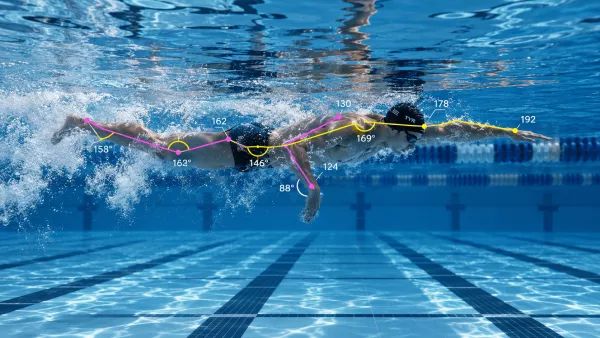
team of researchers has developed SwiMe, a system capable of automatically analyzing a swimmer’s movement from underwater video.
The AI tracks the shoulders, elbows, wrists, hips, knees and ankles. From their trajectories, it can identify certain phases of freestyle, measure stroke and kick rates, and calculate selected joint angles.
In the study, some cadence measurements showed less than 1% error.
And the equipment was nothing exotic: the researchers recorded their tests using GoPro cameras shooting 1080p video at 60 frames per second.
The camera is no longer just a way to watch your swimming. It is starting to become a genuine measurement tool.
The system enables automated analysis of swimming technique without requiring complex motion capture equipment or extensive human annotation.Coifman et al., Sports Biomechanics, 2026
Recognizing a human body in a photo is relatively easy for AI today. Underwater is another story: bubbles, splashes, limbs hidden behind the body, arms repeatedly entering and leaving the water.
In fact, the model used by the researchers performed extremely poorly when applied to swimming footage out of the box: less than 1% average precision according to their evaluation metric.
After being retrained on thousands of annotated images of swimmers, it reached about 92%.
It wasn’t enough to teach the AI to recognize a human. It had to learn what a swimming human looks like.
YOLO: not just a 2012 catchphrase
YOLO is a family of artificial intelligence models, several versions of which are available as open source, designed to analyze images very quickly and identify things they have been trained to recognize. Some versions can also locate key joints and landmarks on the human body.
And adapting YOLO to swimming is not entirely new. An earlier project, YOLOv7-Swim-Pose-Recognition, had already modified YOLOv7 to better recognize swimming poses and different strokes. Its authors reported an improvement of more than 30% in detection confidence and roughly 80% accuracy for stroke recognition.
Further reading
Itay Coifman, May Hakim, Gera Weiss and Raziel Riemer, Human pose estimation for automated biomechanical swimming analysis, Sports Biomechanics, 2026. DOI: 10.1080/14763141.2026.2715647.