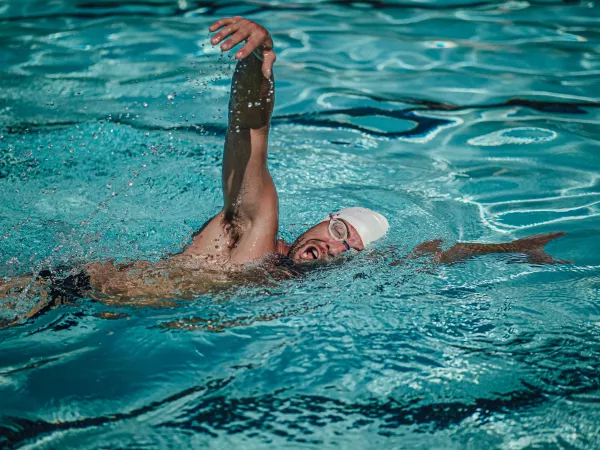
The problem often starts before your mouth leaves the water
Many difficult breaths begin with incomplete exhalation. If you hold air until you turn the head, you have to exhale and inhale in a very short window. The head stays to the side longer and the whole action becomes rushed.
Let air out while your face is in the water instead of waiting for the breath. The inhale can then be brief, using the space created by forward motion and rotation rather than becoming a long stop to empty and refill the lungs.
Turn the head with the body
In freestyle, the shoulders and torso already rotate around the long axis. Breathing uses that rotation. It should not become a separate movement in which the head lifts and then searches far to the side for air.
As the opposite arm establishes its catch, let torso rotation bring you toward the breathing side. The head only needs to follow enough to clear the mouth. A useful cue for many swimmers is to keep part of the face close to the water instead of looking toward the ceiling.
Information
If you are looking at the ceiling, check the rotation first
Looking high is not automatically wrong, but it often means the head has turned farther than necessary. Aim for a low, brief breath that fits your body and the conditions in the pool.
The lead arm is not a kickstand
When breathing feels unstable, the lead arm often presses down to lift the head. That pressure can drop the shoulder and shorten the catch that was supposed to move you forward.
Try to keep the lead arm in a useful position as the body rotates. The breath should happen inside the stroke cycle, not because you added an extra movement to push yourself out of the water.
The best breathing side can change with the situation
Being able to breathe to either side is useful, but that does not mean every swimmer must mechanically breathe every three strokes. Bilateral ability can be trained by switching sides by length or set without forcing a pattern that makes the pace uncomfortable.
The goal is choice, not obedience to a number. In open water, a shared lane, or at a pace where one side feels more natural, adaptability matters more than perfect symmetry.
Two simple drills to feel the difference
Side kicking with breathing isolates head movement without the full stroke cycle. Six-kick switch then connects side balance and rotation. Keep both drills easy and return quickly to full freestyle to see whether the cue transfers.
A good breath is not the one that looks most like a textbook photo. It is the one that gives you the air you need while disturbing the body's path as little as possible.