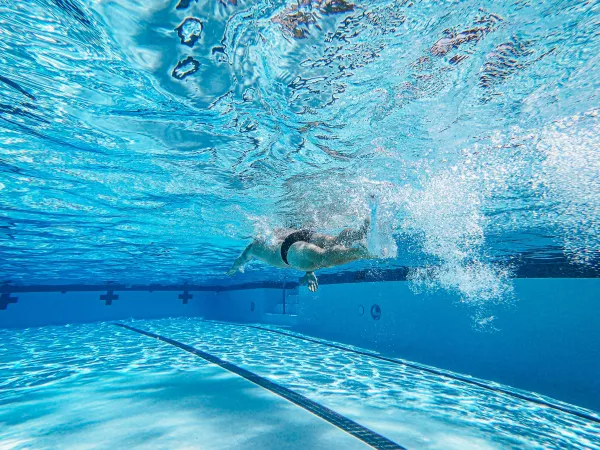
Body position is not a frozen pose
In freestyle, alignment does not mean staying perfectly flat like a board. The body moves forward, rotates, breathes, and creates propulsion. Good position is dynamic organization: the head stays relatively quiet, the torso carries rotation, and the legs follow without unnecessary side-to-side motion.
The goal is to let propulsion move a body that is already organized forward instead of spending energy continually correcting its path.
Start with the head
The head is a useful reference because a small change can affect the rest of the line. Looking forward all the time can encourage the upper body to rise and the hips to sink. Deliberately burying the head is not a universal fix either.
Look for a neutral, comfortable position with the eyes mostly down and slightly forward depending on your build. During a breath, the head rotates with the body and then returns to the same reference.
Let the body rotate around an axis
Shoulder and hip rotation lets the recovering arm move without having to work around a completely flat torso. It also helps position the arm for the next catch. But more rotation is not automatically better.
If you roll from side to side like an unstable kayak, the body creates extra movement it then has to correct. Use enough rotation to free the shoulders and support breathing while keeping the overall path directed forward.
Information
A clean hand entry protects the line
When the hand enters in front of the shoulder instead of crossing in front of the head, it is easier to establish the next catch along the direction of travel. Crossing the centre line can pull the shoulder and torso sideways, creating a correction for the next stroke.
The legs also help stabilize
A freestyle kick does not have to be maximal to matter. For many swimmers, a light continuous kick contributes to body line and rhythm. If the legs split widely on every breath or cross over to regain balance, they may be revealing a problem higher up the chain.
Before deciding to kick harder, ask what the legs are trying to compensate for.
Work on position without swimming slowly forever
Use short technical segments, then return to normal swimming. For example, swim 25 m six-kick switch to feel side balance, followed by 25 m full freestyle. Or use a front snorkel for a few 50s to observe alignment without breathing, then repeat without the snorkel.
The test is transfer. If the organized position disappears as soon as you add a little speed, the work is not finished. Build speed gradually while keeping one or two simple cues. Power then becomes an extension of technique instead of an attempt to replace it.