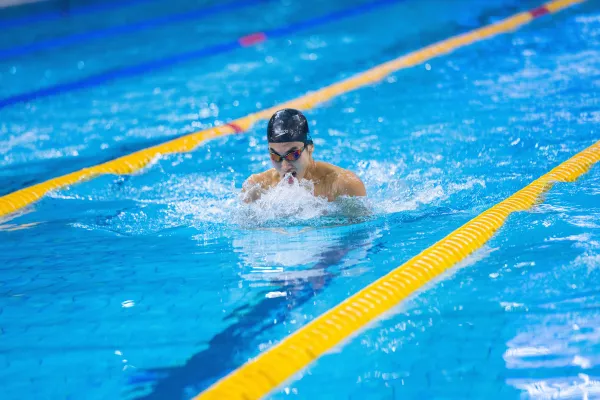
Think in cycles, not two separate engines
It is tempting to train the pull and kick as though both should produce maximum force at the same time. In breaststroke, that often creates a lot of motion for little forward travel. The cycle works better when each action prepares the next.
The pull helps position the upper body for the breath. As the arms recover forward, the legs fold. The kick completes that transition and sends the body back into a long line. The swimmer then uses the speed that was created before beginning the next cycle.
The pull needs to finish early enough
A surface-stroke pull that travels too far under the body takes longer to recover forward. During that time, the legs either wait or kick while the upper body is still creating resistance. Think of a compact action that puts the hands in position to recover forward quickly.
The breath fits inside that action. The upper body rises because the pull and trunk position bring it there; deliberately lifting the head high usually adds more movement than necessary.
The kick belongs to the return to length
The heels recover as the arms move forward. The feet then set for the kick, the legs press water backward, and the feet come together. The useful sensation is that the kick helps finish the body's return to a narrow line.
If you kick hard while the arms are still wide, the two actions interfere. If you wait too long after the arms have recovered, the cycle breaks into separate pieces.
Information
A useful phrase: pull, breathe, recover, kick, lengthen
This is not a universal race formula or a rigid metronome. It is a cue for feeling the order of the actions. As speed increases, the phases move closer together and overlap more without losing that logic.
There is a glide, but not a mandatory wait
After the kick, the body returns to a long position. At easy pace that phase can be very noticeable. At higher pace it becomes shorter. Forcing a long glide on every cycle can let speed fall so much that the swimmer has to accelerate from almost nothing again.
Do not chase a fixed glide count. Instead, finish each cycle in a position where the arms, head, and legs have stopped creating unnecessary resistance before the next catch begins.
Three drills that make timing easier to feel
Two kicks for one arm cycle deliberately slows the sequence and highlights the long body position. Breaststroke arms with flutter kick lets you focus on a compact pull and quick arm recovery. Breaststroke with a brief streamline pause helps you feel the end of the cycle, as long as the pause stays short and does not become a glide contest.
Return to full breaststroke after each drill. The goal is not to become excellent at the drill itself; it is to make the complete stroke more connected.