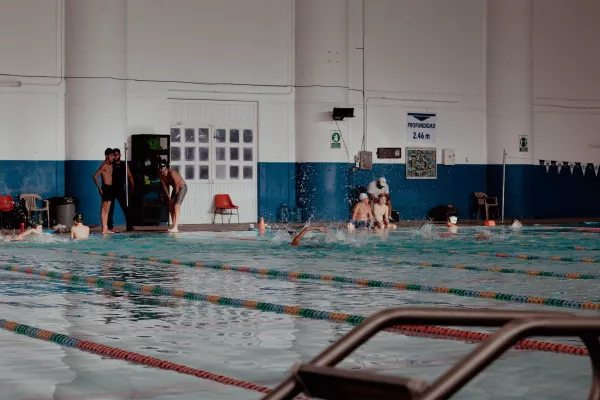
Watch the lane before trusting the label
Slow, medium, and fast are relative categories. Their meaning changes with the pool, time of day, and swimmers who happen to be there. A fast lane on a quiet Sunday may move more slowly than a medium lane during a Masters practice.
Before choosing, watch two or three passes. Notice roughly how long swimmers take for a length, but also whether they swim continuously or take long stops at the wall. The real traffic pattern matters more than one impressive-looking length.
Compare your normal pace, not your best time
The right lane is one where you can do the planned workout without constantly catching the person ahead or being caught every 50. Use your ordinary training pace as the reference.
If you can sprint one fast 50 but today's workout is steady 200s, choose for the 200 pace. A short speed session may temporarily put you with faster swimmers. Lane choice is a practical decision, not a ranking of your ability.
Information
The best clue: is the gap closing?
If you quickly close on the swimmer ahead over a few lengths, the lane is probably too slow for your current pace. If the swimmer behind repeatedly catches you, it may be too fast. A relatively stable gap is a good sign.
Announce yourself before joining
Do not simply drop into moving traffic halfway down the pool. Wait until swimmers reach the wall, make contact, and confirm how the lane is operating. Some public swims split a lane when only two people are present; other pools use circle swimming from the start. Local rules come first.
If the lane is circling, also ask which direction and what spacing they are using. Five seconds is common in many organized groups, but it is not a universal rule. A ten-second conversation prevents a lot of confusion.
Changing lanes during the session is normal
Traffic changes. Swimmers arrive and leave, and someone may switch from kicking to a fast main set. You can start in one lane and move after twenty minutes.
Do it at the wall, without cutting across an active swimmer, and tell the people in the new lane that you are joining. Moving is usually easier than spending an hour defending a choice that no longer works.
A compatible lane makes everyone predictable
When speeds are reasonably close, departures become easier, passing is less frequent, and everyone can pay attention to their own workout. That is the real purpose of lane selection.
You are not trying to prove that you belong in the fast lane. You are looking for a space where your swimming and everyone else's can coexist without a surprise at every wall.