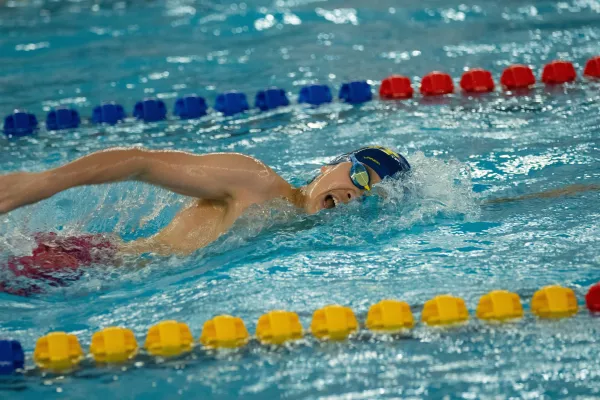
Speed needs freshness
A genuinely fast repeat takes more than high effort. It also requires enough freshness to produce quick, coordinated movement. If you stack sprints with too little recovery, the set gradually becomes fatigue-tolerance work instead of pure speed work.
Both can be useful, but they are not the same objective.
A few fast repeats that stay fast are more useful
25s and 50s work well because they let you produce speed without immediately accumulating too much fatigue. Recovery may look generous compared with an endurance set. That is intentional: it helps preserve the quality of the next repeat.
A set such as 8 × 25 m fast, leaving every 40 to 60 seconds depending on your level, can be more relevant than a long block where each 25 gets slower.
Information
Fast does not mean messy
Choose one technical cue you refuse to lose: a clean hand entry, quiet head position, complete push-off, or a higher stroke rate without completely losing your catch.
If your top speed requires everything to fall apart, you are also rehearsing that breakdown. A slightly slower repeat that is technically repeatable may be more valuable.
Speed can appear in small doses
You do not need a workout devoted entirely to sprinting. A few fast 25s after a good warm-up, accelerations over the second half of a 50, or 15 m very fast followed by easy swimming can maintain speed inside a broader session.
This is especially practical if you swim two or three times per week and do not want to reserve an entire day for a single quality.
Stop when the signal changes
A useful rule is simple: if times drop clearly and technique deteriorates despite adequate recovery, the work is no longer what you planned. Add rest, reduce the number of repeats, or move to the next block.
Speed training is not measured by how exhausted you are at the end. It is measured by your ability to produce fast, clean, comparable repeats.