Your legs are not a second copy of your arms
The arms usually provide most of the propulsion in freestyle, but that does not make the kick unimportant. An effective kick helps keep the hips and feet near the surface, supports body rotation, and can add speed as effort increases.
The useful question is not simply how hard your legs push. A small kick that keeps the body organized can matter even when it does not feel powerful.
A compact kick creates less drag
Freestyle kicking is driven from the hips with relatively long legs and relaxed ankles. The knees move, but they should not become the centre of a bicycle-like action. When the knee drops far below the body or the feet move well outside the bodyline, frontal area increases and the swimmer creates more resistance.
Think of a narrow movement that keeps the feet inside the body's wake. The legs do not need to be rigid. The motion should travel from the hips through the feet without breaking into a large knee-driven kick.
Information
Faster does not automatically mean one mandatory kick pattern
Kick rate often rises as speed rises, but there is no single cadence that fits every swimmer. Some swimmers use a light kick during aerobic swimming and recruit the legs much more at speed; others keep a steadier kick throughout. Look for coordination that supports the stroke without spending more leg energy than the set requires.
The kick also helps organize rotation
Freestyle rotates around the long axis of the body. The kick helps make that rotation stable and continuous. If the legs cross, separate widely, or lose control every time you breathe, the hips can swing sideways and the stroke starts to snake down the lane.
Try a few very easy 25s and pay attention only to what the legs do during each breath. If a large scissor kick appears every time the head turns, the issue may not be weak legs at all. The kick may be compensating for instability somewhere else in the stroke.
Practice the kick inside full-stroke swimming
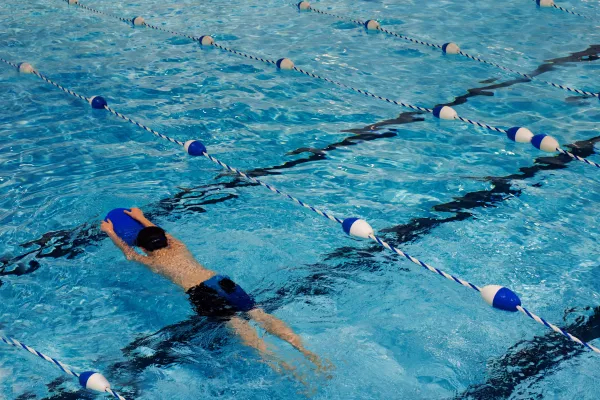
Dedicated kicking has value, but transfer to full freestyle matters more. Try 4 × 50 m as 25 m side or streamline kick followed by 25 m easy freestyle while keeping the same narrow kick. In another set, swim several steady 50s and increase only the leg contribution over the final 10 to 15 metres.
The target is a clear change in speed or stability without making the kick wider or more chaotic.