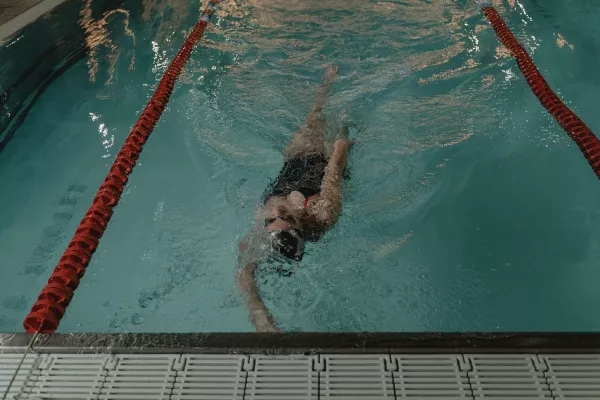
Start with a quiet head
The head gives the rest of the body a reference point. In backstroke, it generally stays in line with the spine instead of rotating with the shoulders. If you lift the chin to look toward the feet or turn the head with every arm recovery, the torso has to compensate and the hips can begin to move side to side.
There is no single head angle that fits every swimmer. Look for a comfortable position where the face is relaxed, the ears are close to the water, and the body can ride high without unnecessary neck tension.
Rotate the body without twisting it
Backstroke is a long-axis stroke. The shoulders and hips rotate around the head-to-toe line so the arms can pull and recover from stronger positions. That rotation still needs to stay organized.
If the shoulders rotate one way while the pelvis is left behind, the body twists and the path becomes less stable. Think of the torso rolling as one unit while the head remains relatively quiet in the centre.
Information
A simple reference: enter in front of the shoulder
A hand entry too close to the centre line can send the arm across behind the head and push the body sideways. An entry that is excessively wide can give away reach. Use the shoulder as a starting reference and adjust for your mobility and feel.
The hips tell you a lot
When the hips and legs sink, drag increases and holding a clean line becomes harder. The kick helps support the lower body, but it should not have to rescue a body position that collapses every cycle.
Float on your back for a few seconds, then add a light kick without changing the head position. Add the arms gradually after that. Moving from simple to complete lets you feel exactly when alignment begins to disappear.
Use poolside feedback, not only the ceiling
Ceiling features can be useful visual references in some pools, but they are not consistent from facility to facility. More transferable checks are the consistency of your swimming: similar stroke counts each length, comparable pressure on the water with both arms, and a steady distance from the lane rope.
On 4 × 50 m easy backstroke, choose one cue at a time. First quiet head. Then hand entry. Then rotation. Fixing everything at once makes it harder to know which change actually helped you swim straighter.