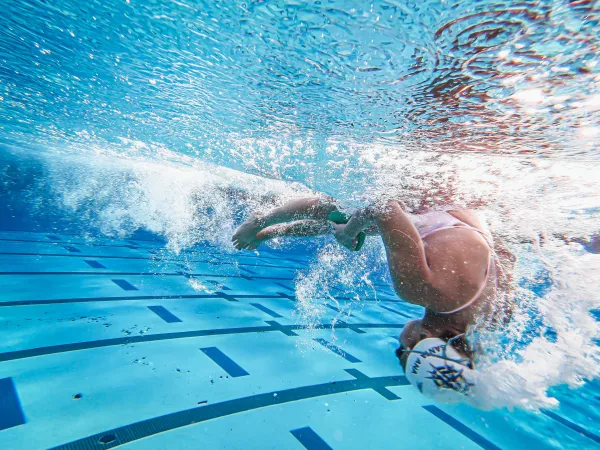
The turn starts before you reach the wall
The first improvement is often the approach. Many swimmers slow down as the wall gets close, shorten the last stroke, or glide too long while trying to hit the perfect distance. That hesitation gives away speed before the turn even starts.
Build a predictable approach instead. Hold your rhythm, learn where the last stroke falls, and refine it over time. In freestyle and backstroke, a flip is easier when you carry speed in. In breaststroke and butterfly, the two-hand touch should also arrive without a long passive glide.
Compact rotation beats frantic rotation
Turning quickly does not mean flailing the arms and legs. In a flip turn, a tight tuck gets the feet back to the wall sooner. In an open turn, bringing the knees toward the chest and redirecting the body compactly keeps you from hanging on the wall.
The priority is to arrive in a position where the feet can produce a strong push. If you constantly miss your foot placement because you are only trying to spin faster, slow the learning process down and rebuild the movement.
Information
The wall is not automatically a rest station
During easy training it is tempting to touch, check the clock, adjust the goggles, and then leave. Do that when you actually need to. Otherwise, keep the turn as part of every length. You can practice dozens of useful repetitions without adding a metre to the workout.
Build the line before you push
A powerful push in a poor position loses speed quickly. Before leaving the wall, put the arms into streamline and create as clean a line as possible from head to feet. When rotation to the front is needed, it can happen through the push-off and transition rather than by pushing sideways.
You do not need an exceptionally long underwater to benefit from the wall. Use the impulse cleanly, then return to swimming without an abrupt break in speed.
Practice one detail long enough for it to survive fatigue
Choose one feature for a workout: maintain speed over the final five metres, tuck more tightly, plant the feet without readjusting them, or leave the wall already streamlined. Repeat that detail on every turn in the main set.
A turn is truly useful only when it still works while you are tired. Daily repetition usually teaches more than an occasional twenty-minute turn session followed by a week of sloppy walls.