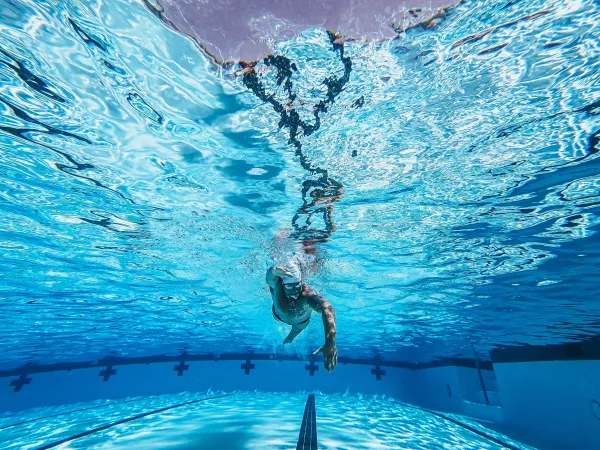
The wall gives you speed; first, keep it
A strong push-off creates immediate acceleration. The first job underwater is to avoid wasting that speed with poor alignment. Arms tight around the head, body long, legs together: the cleaner the shape, the less resistance you create.
That is why a short, well-aligned underwater can be more effective than a long one where speed steadily fades. Distance is not the goal. Preserving speed into the next stroke is.
Add only movements that help you move faster
In freestyle, backstroke, and butterfly, underwater dolphin kicks can extend wall speed when the swimmer has learned to perform them efficiently. They should stay connected to a streamlined bodyline rather than becoming a large motion that breaks the shape. Breaststroke uses a different regulated underwater sequence with its own pull and kick.
For a developing swimmer, a clean streamline push followed by a smooth breakout is already excellent work. There is no benefit in adding several dolphin kicks if each one slows you down.
Information
The question is not how long you can hold your breath
Underwater work is not maximal breath-holding practice. Do not hyperventilate to extend the distance, and do not delay breathing at any cost. The CDC explicitly advises against hyperventilating before underwater swimming and prolonged breath-holding. If you are running out of air or have slowed below your surface swimming speed, the breakout is already too late for the technical purpose of the set.
The breakout should join the stroke, not restart it
A good breakout happens while the body still carries speed. The first stroke connects to the rise toward the surface instead of starting after a long passive ascent. The best distance varies with push-off power, bodyline, underwater skill, and the swimmer's ability to maintain speed.
A useful drill is to notice where the glide or kicks begin to slow sharply, then try breaking out slightly before that point on the next repeats.
In racing, 15 m is a limit, not a target
The current World Aquatics competition regulations allow a swimmer in freestyle, backstroke, and butterfly to be completely submerged after the start and each turn for no more than 15 m; by that point, the head must have broken the surface. Breaststroke uses a different underwater rule.
That limit does not mean every swimmer should aim for 15 m from every wall. Many swimmers are faster and more sustainable with an earlier breakout. In training, find a distance where speed, technique, and breathing still fit together, then make that distance repeatable.