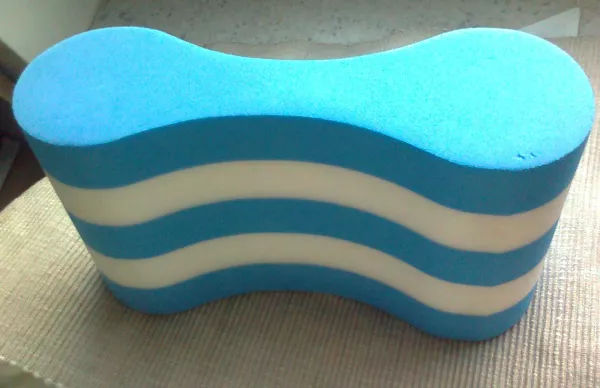

It changes body position first
Placed between the thighs, the foam adds buoyancy near the hips and helps the legs stay higher. That often reduces lower-body drag and lets you swim without an active kick.
The feeling can be pleasant, but it is not exactly your normal freestyle. The pull buoy is artificially supplying part of the balance that you need to create without equipment.
That makes it useful for isolating the upper body
With much of the leg action removed, you can devote more attention to the catch, arm path, and rotation. It is also an easy way to vary the load inside a workout.
Keep the swimming technically clean. If you simply pull harder while the shoulders tighten and the hands lose their grip on the water, the equipment is no longer helping you isolate what you intended to train.
Information
The best feedback comes from comparing with and without it
Swim 4 × 50 m with a pull buoy while noticing bodyline, then 4 × 50 m without equipment at a similar perceived effort. If the hips drop sharply or the stroke becomes much less stable without the buoy, you have identified something to work on rather than a reason to use the buoy more often.
It can hide a problem as easily as it can reveal one
A swimmer whose legs sink may feel that everything is fixed as soon as the pull buoy goes in. That is useful information: lower-body position is probably contributing significant drag. The buoy does not tell you why that position deteriorates without it.
The cause may involve head position, alignment, kick, or how the body handles breathing. Use the buoy as a comparison, not as a permanent correction.
Choose the tool for the set, not from habit
A pull buoy fits well in a set focused on upper-body mechanics or a stable bodyline while you work on the catch. It is less useful when the goal is specifically arm-leg coordination or kicking.
Moving the buoy to the ankles greatly increases the stability demand and changes the task again; it is not an automatic progression. For most swimmers, between the thighs is the simpler starting point.