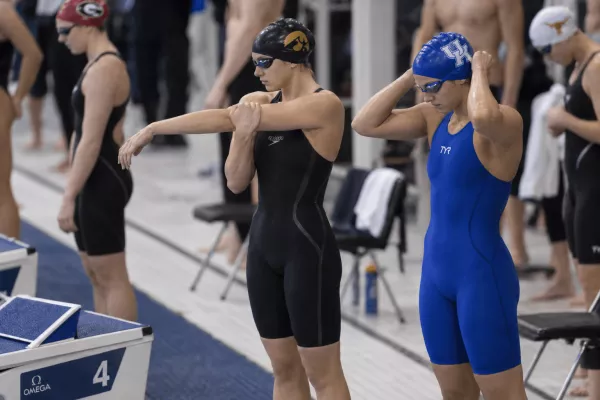
Why wear a tech suit?
A tech suit is designed first and foremost to reduce drag. The fabric absorbs very little water, its surface is engineered to be hydrophobic, and its compression holds the body more firmly than a training suit.
The effect is real, although it should not be treated as magic. In a study of 12 trained male collegiate swimmers performing a maximal 25 m front crawl, average swimming velocity increased from 1.74 m/s in a conventional suit to 1.77 m/s in a jammer-style racing suit, or roughly 1.7%. Distance per stroke was also slightly higher.
The sample was small, male, and limited to a very short sprint. This is not a promise that every swimmer will become 1.7% faster in every race. It is measurable evidence that a properly fitted racing suit can provide a small performance benefit.
Moriyama S-I, Mankyu H, Tsunokawa T, Kurono T, Mizukoshi H, Ogita F. Does a jammer-type racing swimsuit improve sprint performance during maximal front-crawl swimming? Sports Biomechanics. 2024;23(5):611–623. DOI: 10.1080/14763141.2021.1878263.
The little code that matters
For competition, check that the model is approved by World Aquatics when the meet rules require it.
On many recent models, the approval label includes a QR code and a reference number. The QR makes it easy to check the model; the number can also be searched in the official World Aquatics database.
The QR code shown here opens that database directly. It is a SwimQuest shortcut to the official tool, not the code printed on your own suit.
For men, the suit cannot extend above the navel or below the knee. For women, it cannot cover the neck, extend past the shoulders, or go below the knee.
You may also see American rules restricting certain tech suits for swimmers aged 12 and under. Those are USA Swimming rules and do not automatically apply in Quebec.

Speedo, Arena, TYR, Funkita…
Each major brand has its own range. Speedo offers the Fastskin LZR Pure Intent 2.0 and Pure Valor 2.0, among others. Arena’s Powerskin line runs from the ST Next through the Carbon Air², Carbon Glide, Carbon Core FX and Primo. TYR has models such as the Venzo and Avictor. Funkita and Funky Trunks offer the APEX. Mizuno, FINIS and Jaked also occupy part of the market.
The most expensive suit is not automatically the best choice for every swimmer. Two approved tech suits can feel very different around the hips, thighs, shoulders, or in their overall compression. Fit and comfort in swimming position matter a lot.
How should you shop for one?
If possible, try the model on before buying it. Size charts are useful, but they do not completely replace a fitting. Most importantly, do not automatically size down just because a tech suit is supposed to be tight.
For a first purchase, entry-level or mid-range models are often more than enough. A previous-year model can also be a very good deal if it is still approved and available in the right size.
Buying used can reduce the cost, but be careful. A suit that has seen a lot of racing may have lost some of its compression or may have been damaged while being put on.
You also have to get the thing on
The first time, allow a good 20 to 30 minutes. Both the swimmer and the suit should be dry. Remove jewelry and watches, and be careful with fingernails.
Work the fabric upward gradually, a few centimetres at a time, instead of pulling from the waistband. First position the knees correctly, then the crotch and hips. If the fabric is still sitting too low somewhere, yanking harder from the top will not fix it. Go back down and redistribute the tension.
One useful trick: try using dishwashing gloves or, even better, silk gloves. They reduce the chance of catching the fabric with your nails.
For a kneeskin, the straps go on last, once the lower half is properly positioned. And practice at home before the meet. Fifteen minutes before a race is not the time to learn how the suit works.
How long should you wear it?
No longer than necessary. Warm up in your regular suit, dry off, then put the tech suit on before your race.
If your events are close together, keep it on. If you have a few hours before the next one, take it off. Chlorine wears the fabric, but repeatedly taking a tight suit off and putting it back on does not help either.
After your final race, rinse it in cold water and let it dry flat.
How many meets will it last?
A tech suit can wear fairly quickly, especially a highly compressive model. Over time it feels less tight, the fabric stretches and water no longer beads off the surface as well.
There is no precise number of meets that applies to every suit. Depending on the model, how often it is used and how it is cared for, some swimmers reserve their best suit for a few important meets while others use the same one for an entire season.
If it becomes much easier to put on, starts to wrinkle while being worn or clearly no longer feels as compressive, it has probably lost part of its effectiveness.
Rome 2009 and the supersuit era
In the late 2000s, the technology race went much further. Full-body suits used highly impermeable synthetic materials, including polyurethane.
At the 2009 World Championships in Rome, 43 world records fell in eight days. César Cielo swam 46.91 in the 100 m freestyle wearing an Arena X-Glide. His world record stood for more than 13 years.
FINA then reviewed hundreds of models and tightened its rules around materials, thickness, buoyancy and air trapped inside the suit. Beginning in 2010, racing suits had to return to textile materials and their body coverage was sharply restricted.
The full-body supersuits disappeared. The modern, much more tightly regulated tech suit took their place.
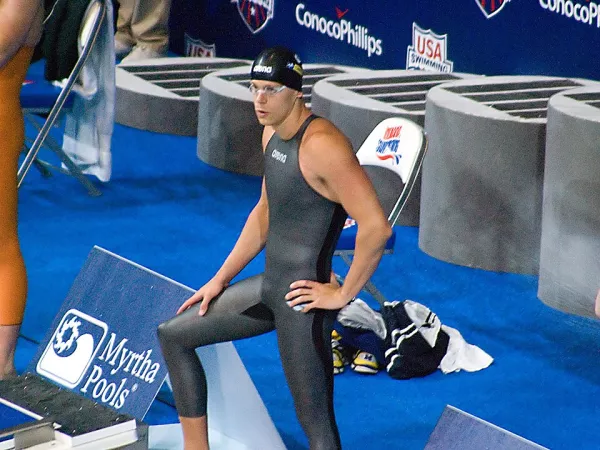
Credit: myuzeme License: CC BY-SA 2.0

At 10, 11 or 12: “I want a tech suit too”
Younger swimmers see older athletes arrive at meets with tech suits. It is perfectly normal for them to want to try one too.
Spending $600 on a 10- or 11-year-old swimmer generally does not make much sense. That does not mean they necessarily have to wait several years. An entry-level model already lets them experience the compression, fit and particular ritual of wearing a tech suit.
There is also a psychological dimension. A swimmer who puts on a tech suit and feels faster walks behind the blocks carrying that belief. It is difficult to separate precisely the effect of the suit, the ritual, and the swimmer’s expectations. If part of the effect is in their head, the race itself is still very real.
An approved model in roughly the $100 to $200 range can therefore be perfectly reasonable, especially for a young swimmer who already competes and wants to use one at meets.
Just keep in mind that at that age, growth can quickly turn a perfectly fitted suit into one that is too small.
For a first tech suit: approved, properly fitted, within budget, and not so expensive that replacing it after a growth spurt becomes painful.